
Projected and Actual Platte County Release Dates
A projected date is an expected or calculated milestone. An actual release date and time is a completed custody transaction. For the Platte County Detention Center, the sheriff’s record establishes when county custody ended. It must also identify the release type or destination before the event can be described as release to the community.
| Missouri or local term | What the source means | What it does not prove |
|---|---|---|
| Sentence-I Minimum Release Date | MODOC’s calculated minimum date on the active sentence | Actual physical exit or Board approval in every case |
| Minimum Release Date | The MODOC glossary identifies it as the conditional-release date | Complete discharge from supervision |
| Presumptive Parole Release Date | A tentative Board-assigned date contingent on conduct and an acceptable plan | Guaranteed release |
| Maximum Release Date | Sentence expiration or completion in MODOC material | That no other sentence, warrant, or hold exists |
| Actual jail release date/time | The custody transaction held by the jail | Whether another authority immediately took custody |
A person may be outside prison on parole or conditional release while still under MODOC authority. Discharge is the later end of the represented supervision period. Collapsing those stages can make a valid projected date look like sentence completion when it is not.
Find Platte County Projected Release Dates
The search route changes with custody. A Platte County jail detainee who never entered MODOC should be checked through the sheriff and court. A person serving a Missouri prison sentence should be checked through state records, even if the criminal case began in Platte County and the prison is elsewhere.
- Identify the episode: pretrial county detention, county sentence, Missouri prison sentence, or federal custody.
- For an active Missouri prisoner, open MODOC Offender Web Search and note its “data current as of” time.
- Search the name and a known alias when appropriate, compare identifiers, and open the correct active result.
- Copy each displayed date with its full label. Do not convert a minimum, maximum, conditional, or presumptive date into “release date.”
- Review the MODOC Sunshine fields and Parole Board rules for the sentence context.
- For a Platte County jail case, inspect Missouri Case.net and request the county sentence calculation, jail credit, release authorization, and holds from the sheriff.
- Ask the institutional parole officer about a case-specific state date or home plan, as the Missouri Parole Board directs.
The captured MODOC active-offender search shows the official starting point for an active state prisoner, probationer, or parolee.
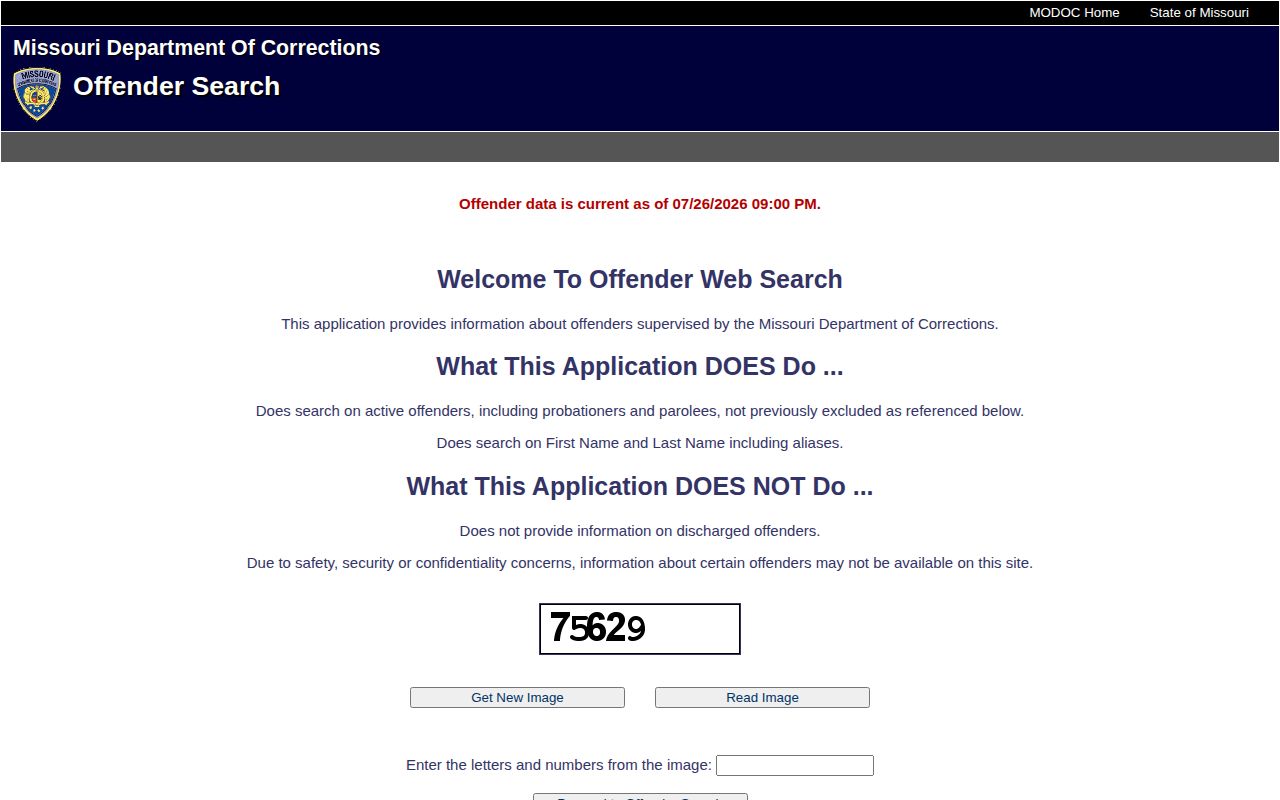
The search is active-status only. Its exclusion of discharged offenders means a missing result must lead to the Sunshine file or a records request, not to a claim that state involvement never occurred.
Platte County Jail Release-Date Records
The Platte County Detention Division offers a “Current in Custody” route, not a published release-date calculator. A person held before trial has no sentence-based projected date. Bond, recognizance, dismissal, plea, trial, a warrant, or another court order may determine when custody changes.
For a county sentence, ask for the actual calculation rather than applying a state-prison formula. A targeted request can seek the booking and release record, the county sentence, jail-credit entry, release authorization, release date and time, release type, and any destination or receiving agency. Use the sheriff’s online records request or route the request to the detention records custodian.
The sheriff lists 11724 NW Plaza Circle, Kansas City, MO 64153, 816-858-2424, and administrative hours Monday through Friday from 8 a.m. to 5 p.m. Confirm whether an in-person request is accepted before traveling. The countywide Sunshine form can help with routing, but the sheriff is the logical custodian for a detention release record.
Missouri Release Fields for Platte County Sentences
MODOC’s nightly Sunshine file covers people who are or have been under department supervision, with data dating as early as 1974. Relevant fields include DOC ID, assigned place, field or institution indicator, court cause number, sentence county, completed flag, sentence date, Sentence Maximum Release Date, and Sentence-I Minimum Release Date. The file can contain one record for each charge connected to current supervision. Concurrent and consecutive indicators matter. A completed flag on one row does not prove that every sentence and every form of custody ended. Match Platte as the sentence county, compare the court cause number, and inspect all related rows.
The successful manifest image comes from the official MODOC Sunshine Law documentation.
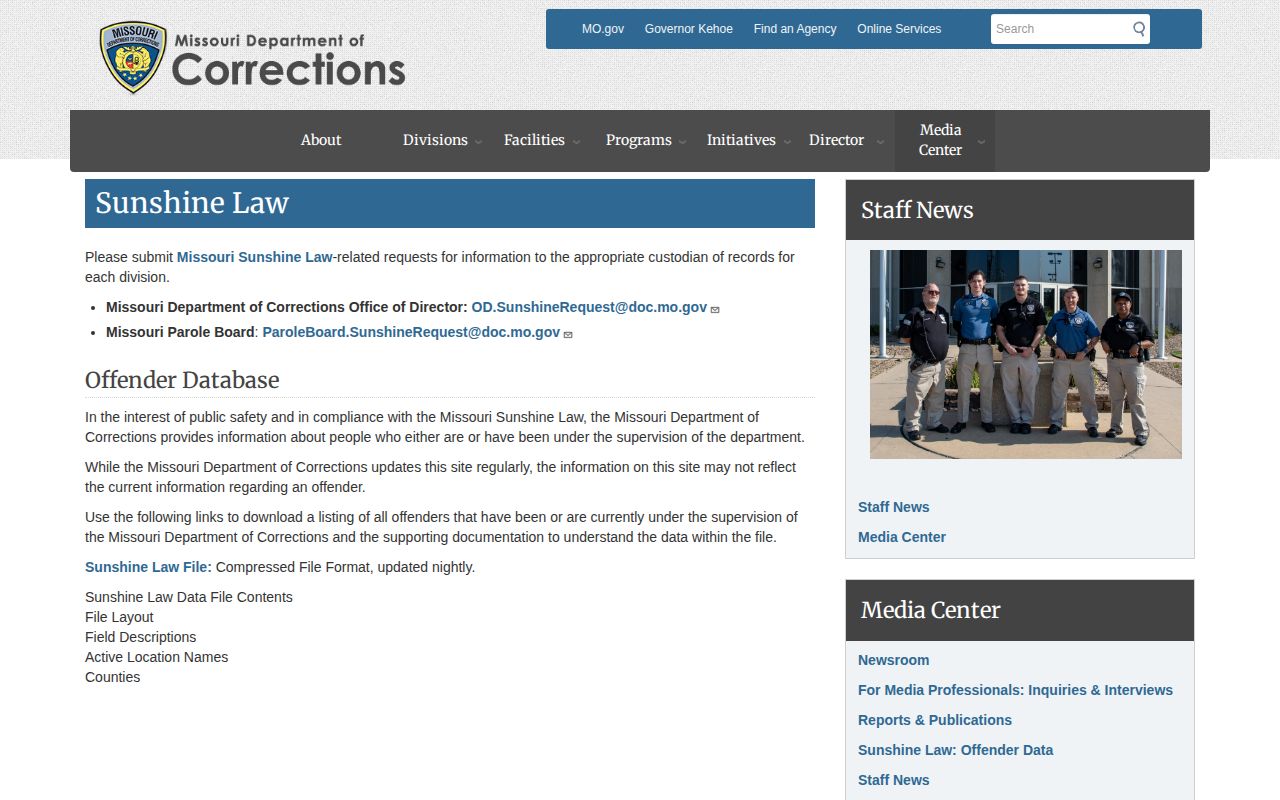
These documented historical fields carry the lookup when the ordinary name search no longer returns a fully discharged person.
MODOC cautions that the Sunshine file is a copy of working data and does not represent it as complete or error-free. Resolve conflicts through the institutional or field officer, Constituent Services, a targeted Sunshine request, and the court record tied to the same cause number.
Platte County Sentences and Conditional Release
Missouri § 558.011 divides many qualifying felony sentences into prison and conditional-release portions. For terms of nine years or less, the default conditional-release component is one-third. For terms between nine and fifteen years it is three years, and for terms over fifteen years it is five years. Statutory exceptions apply.
The Missouri Parole Board can extend a conditional-release date after the statutory process for institutional rule violations. That possibility is one reason a minimum or conditional date cannot be treated as a promise. The offense, offense date, sentence structure, Board action, conduct, and any other active sentence must all be read together.
A presumptive parole date has its own contingency. The MODOC glossary describes it as a tentative Board-assigned date that depends on continued appropriate institutional behavior and an acceptable release plan. The MODOC family and friends handbook also distinguishes minimum mandatory, maximum, and conditional release dates. The Board may instead deny parole and use a conditional or maximum date, or set a future hearing. The public hearing process says a decision generally takes about eight to twelve weeks, so a hearing date is not the date a person leaves the institution.
These state rules do not automatically govern a Platte County misdemeanor sentence. The court and jail records control the local calculation. A sentence from a Platte County case can also be served in a prison elsewhere in Missouri, since research identified no MODOC prison within Platte County.
When Missouri’s 85 Percent Rule Applies
Missouri § 558.019 is not a rule that every incarcerated person serves 85 percent. Its current subsection 3 applies the 85-percent minimum to a person convicted of a dangerous felony, subject to the statute’s alternative involving age seventy after at least 40 percent has been served. Subsection 2 also contains specified minimums tied to applicable prior prison commitments.
The safe description is “85 percent for a dangerous felony under § 558.019.” Whether it applies to one Platte County sentence depends on the conviction, statutory version, offense date, and sentence record. Section 217.690 and the Parole Board rules add separate authority and limitations. Eligibility does not guarantee release on a calculated date.
When the percentage matters, locate the judgment, offense statute, and offense date rather than applying the phrase to a name-search result. Section 558.019 also identifies other minimums connected to qualifying prior prison commitments. A current legal calculation may require the statute effective for the offense and all linked sentences. The agency’s labeled date and case-specific calculation remain more reliable than a percentage worked backward from the imposed term.
What Changes a Platte County Release Date?
An expected date can move because the records behind it change or because a condition was never satisfied. The cause must come from a court, correctional, parole, or custody record. It should not be inferred from roster disappearance or a date copied without its label.
| Factor | Possible effect | Record to check |
|---|---|---|
| Concurrent or consecutive sentences | Changes how multiple terms overlap or follow one another | Judgment, cause numbers, MODOC sentence rows |
| Jail-time credit | Changes time credited toward a sentence | Court order and sentence calculation |
| Mandatory minimum | Limits release eligibility | Conviction statute and current § 558.019 |
| Board decision | May set a presumptive date, deny release, or schedule a later hearing | Parole Board record |
| Institutional misconduct | May support a conditional-release extension through the required process | MODOC and Board record |
| Home-plan contingency | Can keep a presumptive date tentative | Institutional parole office |
| Amended judgment or new case | Can alter the controlling legal basis | Case.net and certified court record |
| Warrant, detainer, or transfer | Can continue custody under another authority | Release destination and receiving agency |
| Recalculation | Can replace an earlier projected value | Current agency calculation and timestamp |
A projected field should be copied with its exact label and the date the source was checked. “Minimum,” “maximum,” “conditional,” and “presumptive” describe different points in Missouri’s sentence and parole framework. None is interchangeable with the minute a person physically leaves a jail or prison.
When a factor changes, return to the office that controls it. Court staff can address a judgment or amended order, MODOC can address its sentence calculation, and the institutional parole office handles a case-specific home-plan question. MODOC Constituent Services can route general search and policy questions, though confidential case details remain restricted. A receiving agency must confirm continued custody after a detainer or transfer.
Why Missouri Release Dates Need Two Searches
Missouri publicly documents minimum and maximum sentence fields in its nightly Sunshine file even though the ordinary Offender Web Search excludes discharged people. That produces a useful but easy-to-miss two-path system for Platte County cases. Use the public name search for an active prisoner, probationer, or parolee. Use the historical file or a targeted MODOC request after full discharge.
The same documentation distinguishes a conditional minimum date from a presumptive parole date that remains contingent on conduct and an acceptable plan. At the county level, no researched Platte County good-time or weekend-release formula fills that gap. A county calculation must come from the court or jail record.
A targeted MODOC request can name the DOC number, full name, birth date when appropriate, Platte County court cause number, sentence, requested minimum and maximum dates, presumptive date, actual release or parole date, and supervision discharge date. The department may redact confidential material. For Board records, the published Sunshine address is ParoleBoard.SunshineRequest@doc.mo.gov. For a specific release date or home plan, the Board page directs the question to the institutional parole office.
Confirm a Platte County Release Date
Build confirmation from the correct pair of records. For the county jail, combine the sheriff release report with the Case.net order that explains bond, dismissal, sentence, or probation. For a Missouri prison case, combine the exact MODOC date labels with the institutional parole office or Board record. For a transfer, follow the receiving authority.
A pending custody-change notice can help with timing, and the Platte County VINE inmate check explains registration and transfer alerts. An alert remains supporting notice. The actual record should show whether the person entered the community, remained on state supervision, or moved directly into another custodian’s control.
Keep the source timestamp with every date. If an older screenshot, court docket, and current agency record disagree, use the newest authoritative calculation and ask the custodian to explain the change. A date without its source, label, and “as of” time cannot reliably distinguish a forecast from a completed Platte County release.